Sunday, April 19, 2015
Japan: Birthday girls
Nina turned 7 while we were in Japan, so we got to attend her birthday party. Several of her friends came over for play time and birthday ice cream. We understand that this is not traditional Japanese practice and is part of Kevin and Chikako's master plan to raise children who are culturally at home in both America and Japan.
This photo also demonstrates the utility of futons as a sleeping solution when space is at a premium. In the back of the photo, you can just see Sam and Nina's futons, folded out of the way to make room for playing. At night, they would be sleeping right where the birthday action is taking place.
This crazy popcorn popping game was a big hit! It basically involved trying to catch ping pong balls when the popper shot them out.
For dinner, we went to Coco's, which Kevin describes as "Japanese Denny's." It's a Japanese take on an American family restaurant, complete with free refill soda fountains and birthday shenanigans. In addition to the silly hats, the birthday girls each got a free piece of cake and a washcloth, and the wait staff sang them a happy birthday song. You can just barely see the yellow and blue washcloth in the bottom left corner.
Happy Birthday Juniper in Japanese (and in chocolate sauce).
Friday, April 17, 2015
Japan: A quiet morning in Gifu
Our friends live in a quiet residential area. At one end of their block is a small river; at the other end of the block is a large grocery store, Seiyu (which is actually owned by Walmart). In the middle of the block is a small neighborhood park. The elementary school and a train station are both a short walk away, as is a 7-11 with an ATM that accepts international bank cards (no big deal for the Sugiyama-Allen family, but a great asset for their American guests). We're jealous--it's a pretty terrific living arrangement.
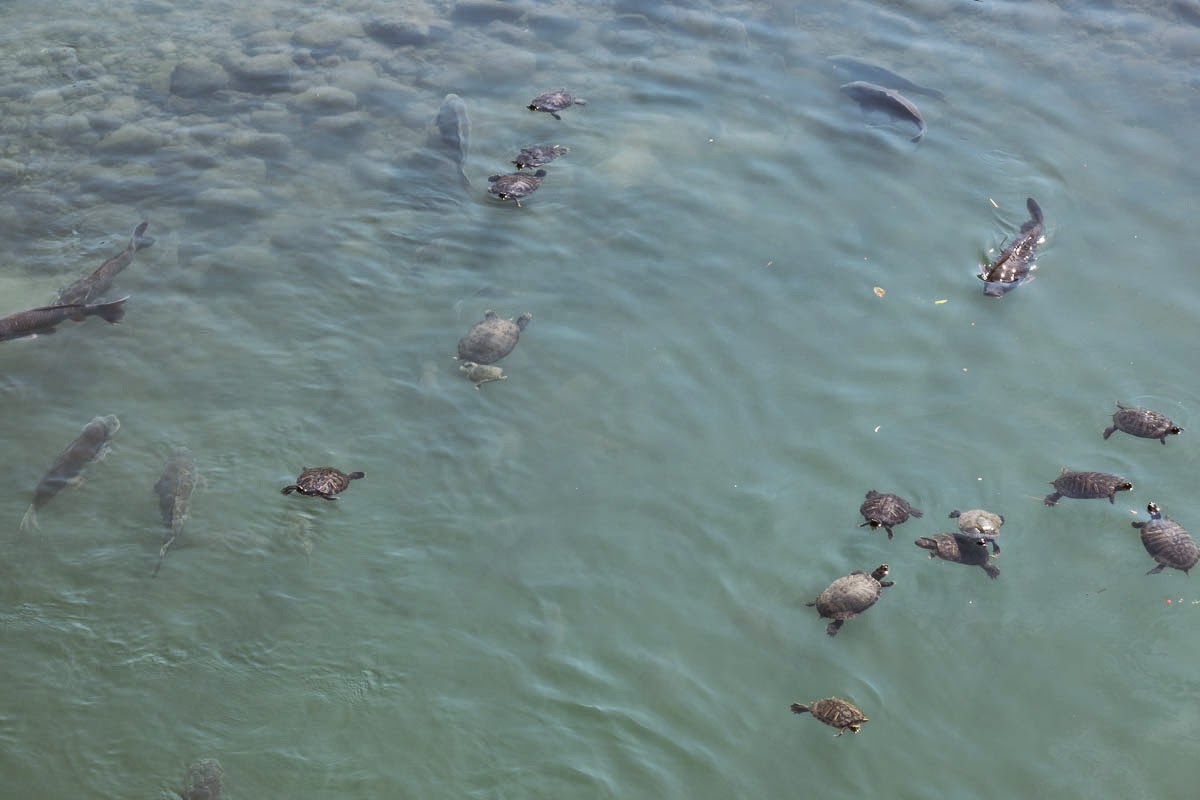
One morning, we wandered down to the river and discovered that it is a fantastic spot for viewing turtles and koi--especially turtles. Lots and lots of turtles.
After the river, we hit the Seiyu's prepared foods section and snack food aisles to get supplies for a picnic. We carried everything to the park, where we enjoyed a lovely meal and some fun play time. Juniper didn't want to share her sushi tray, even though we were dubious that she would finish it. She proved us wrong by eating all of it, except for the octopus (which she tried and proclaimed too chewy).
This particular block wouldn't make it on to any guide book list of sights to see, but it was a delightful place to spend a morning.
Wednesday, April 15, 2015
Japan: Conveyor belt sushi
Eating at the conveyor belt sushi restaurant may have been the highlight of our trip for Juniper, so I've invited her to help me caption these photos. Everything in italics is from her.
So much sushi on the conveyor belt! I love it!
Why does Hazel have all the pictures? That one with the sign does look good, on the conveyor belt of course. She's pointing to some sushi on the conveyor belt; I'm sure it's shrimp.
Because Hazel was at the table with Aaron (and the camera); Juniper was sitting at the other table, with Chikako. Juniper is correct that Hazel does love shrimp. She basically subsisted on white rice and shrimp, with the occasional noodle, for most of our non-breakfast meals. She describes sushi as "rice, and sometimes nori, with food on top."
That's the plastic bullet train that brang us sushi. Sushi means rice. Sushi is my very favorite food. You take it off the conveyor belt at this restaurant. YUM!
You could take food off the regular conveyor belt, or special order exactly what you want using the touch-screen computer at each table. Special orders came on the top track, delivered by bullet train.
That's shrimp, our very favorite fish. I also love nori.
Finally, one of me--even though I'm peeking through a little window.
Happy kids at a fun restaurant!
This is an unrelated comment for the Applegath family members: I've mentioned before that I think Juniper looks a lot like Katy, especially in her nose and smile. I really see that resemblance in this photo!
Sunday, April 12, 2015
Japan: Oasis Park
Our first few days in Japan, Sam and Nina were still in school. Once their school break began, we started going on adventures with the whole family. We visited Oasis Park, a public park with a theme of celebrating the waters and natural beauty of Japan (or maybe just of the Gifu prefecture?). The kids were excited about the many koi in the park streams.

They also enjoyed looking down on the adults from the tall bridge over the stream.
Park staff tending to the flowers in one waterway. This photo is just one example of how well tended the public places were. Bushes were pruned; trees were labeled and supported; litter was virtually non-existent. At one temple we saw staff carefully sweeping the mossy ground free of leaves.

More koi--some quite big!
One section of the park included a traditional wood home, with thatched roof.
Up close, it was impressive to see just how thick the thatch was: probably 14-18" thick.
The park had a fun playground with a zip line swing...
..and a restaurant where all three girls got ramen.
Throughout the trip, Juniper and Hazel were delighted that Japanese table manners allow for slurping your noodles and soup.

We ended our trip to the park with a visit to the Gifu aquarium, where Hazel was attacked by a giant piranha. Ok, not really. But we did see some piranhas.
Sometimes, Jedi battles can be as much fun as any other vacation activity.
Saturday, April 11, 2015
Japan: Inaba Shrine

Another Gifu site we visited was the Inaba Shrine. This is one of the most prominent Shinto shrines in Gifu, particularly for New Year's celebrations.
In this blog post and all that follow, please take any of my comments about Japanese culture, religion, or other practices for what they are--the well meaning observations of an ignorant tourist who has spent very little time in the country. I'm sure there is much I misunderstood, misremembered, or simply got wrong. The mistakes are all mine, not our hosts'.
Speaking of my own ignorance, there is a Buddhist temple immediately at the base of the Inaba Shrine. There is a lot of overlap between Buddhism and Shintoism in Japan--both in terms of architectural style and religious/cultural practice. It is entirely possible that I may have mixed up photos or information between the two. Sumimasen. (If you want the simple explanation of this ubiquitous Japanese word, it's an apology. If you like to geek out on linguistics, then you will enjoy this more in-depth explanation of sumimasen.)
The Inaba Shrine was first built at this location in the 1500. There have been ongoing additions and renovations over the past 500 years, as this is a living shrine and not just a historical site. The shrine holds sacred relics and is typically not open to the public, although it is occasionally opened on special festival or holy days.

Visitors can purchase these ema, small wooden cards on which to write a prayer, blessing, or request. The ema are then hung up in the shrine until a specific day, when they are burned. Many (all?) of them are burned on or around the new year, with the intention of clearing away the previous year's emotional and spiritual clutter to have a clean start to the new year. (I'm not sure whether that is typical of all Shinto shrines, or specific to this one, where the New Year's celebration is a big deal.) The ema are hung in designated places, which are often associated with particular deities or spirits who offer specific types of blessings. For example, at one famous shrine popular with foreign tourists, Kevin pointed out a spot for prayers to a deity associated with good vision and eye health. Many non-Japanese-speaking tourists had written general statements of thanks or wishes for happiness or success--prayers not likely to be granted, unless they were hoping for clear vision to recognize happiness or success when it crossed their path.

A view of the shrine's entrance from the top of the stairs, with Gifu in the background. You can see the gate, which is an important feature of Japanese architecture. You can also see lots of bare cherry trees. I gather that we were in good Japanese company on the quest for blooming cherry trees.
This waterfall is noted as the shrine's "power spot." I'm a little fuzzy on what exactly that means, but as best I understand, this is a place of especially powerful spiritual energy. Chikako told us that Sedona, Arizona is a popular destination for Japanese tourists because it is an extremely potent power spot.
The girls enjoyed following Chikako's example in various practices, including kneeling here and banging these sticks together. (I'm sure there is a more accurate and respectful term than "sticks." Sumimasen.) The fountain where you ritually wash your hands before entering the shrine was also a big hit; Hazel especially enjoyed being allowed to drink from the water dippers.
Stones for remembrance. I wonder what makes this practice resonate across so many cultures.
These Torii gates mark the approach to a Shinto shrine.
Note the rope with the zig-zag paper strips. This marks the boundary to something sacred and can be seen all over Shinto shrines. If you look closely, you'll be able to find it in several of these photos.
This is a zoomed out view of where the girls were standing in the previous picture. It was a lovely spot...
...but our girls were most excited about the fact that it was a good vantage point for seeing turtles.
This is the view from the parking lot, at the base of the entrance to the shrine. Behind the buildings, you can see the rise of Mt. Kinka (also known as Mt. Inaba, hence the name of the shrine). I don't think it showed in the previous photos, but the entire shrine is set into the side of the mountain, which adds to the beauty of the setting.
Like the shrine, the Buddhist temple is only opened on special occasions. I believe this temple at the base of the Inaba Shrine is only open to the public once every 7 years. With our eyes adjusted to bright sunlight, we couldn't really see anything when we looked into the dark temple. However, Aaron's camera was able to capture this picture of the holy items inside the temple.
Thursday, April 9, 2015
Japan: Plum Park
We scheduled our trip based on the Japanese school calendar, but an extra advantage to a spring trip was the possibility of seeing cherry blossoms. When we first arrived in Gifu, the cherry trees had not yet blossomed, but the earlier-blooming plum trees were on full display.
Our first day in town, Kevin and Chikako took us to the plum park. This Gifu city park features numerous species of plum trees, all helpfully labeled (at least, helpful if you read Japanese).
In addition to lovely plum blossoms...
...the park had a playground that was fun for kids...
...and grown-ups too.
One of the things we remarked on during our trip was how frequently we came across tiny spots of focused and intentional loveliness. These were often, but certainly not always, tied to shrines or temples.
The annual plum festival happened shortly before we arrived. The festival is timed to coincide with the peak of the blooming season, but a spell of cold weather delayed the blooming calendar. Bad luck for the Gifu plum festival, but good luck for us!
Wednesday, April 8, 2015
Japan: Getting there
We recently returned from a fantastic two-week trip to Japan where we visited our friends Kevin, Chikako, Sam, and Nina. This will be the first of several blog posts about the trip.
We had about 24 hours of travel time, with flights from Atlanta to San Fransisco, San Fransisco to Tokyo, and Tokyo to Nagoya, followed by a train ride from Nagoya to Gifu. The fantastic seatback entertainment kept the girls entertained on the flight to San Fransisco. Sadly, there was no seatback entertainment on the very long flight across the Pacific.

Ever the champion sleeper, Juniper napped on the first flight and slept for several hours on the long flight.
Hazel had a harder time of it, but after some weeping and sorrow she did finally manage to fall asleep. All in all, the girls were troopers on this very long travel day.
We were pooped upon our arrival, but jet lag had us up bright and early the next morning. Hazel joined Kevin in walking his kids Sam and Nina to school. Hazel and Nina hit it off immediately and continued going strong for the rest of the trip.
The girls' first bath together was also their last bath together. There was no temperature that worked for all three--either Nina was freezing, or Juniper and Hazel were burning. As Kevin described it, Japanese children are trained from an early age to tolerate hot baths.
We had about 24 hours of travel time, with flights from Atlanta to San Fransisco, San Fransisco to Tokyo, and Tokyo to Nagoya, followed by a train ride from Nagoya to Gifu. The fantastic seatback entertainment kept the girls entertained on the flight to San Fransisco. Sadly, there was no seatback entertainment on the very long flight across the Pacific.

Ever the champion sleeper, Juniper napped on the first flight and slept for several hours on the long flight.
Hazel had a harder time of it, but after some weeping and sorrow she did finally manage to fall asleep. All in all, the girls were troopers on this very long travel day.
We were pooped upon our arrival, but jet lag had us up bright and early the next morning. Hazel joined Kevin in walking his kids Sam and Nina to school. Hazel and Nina hit it off immediately and continued going strong for the rest of the trip.
The girls' first bath together was also their last bath together. There was no temperature that worked for all three--either Nina was freezing, or Juniper and Hazel were burning. As Kevin described it, Japanese children are trained from an early age to tolerate hot baths.
Subscribe to:
Posts (Atom)